nSuns 5/3/1 LP is a high-volume strength program built on percentages of a training max, set at 90% of your one-rep max. Each day has a main lift for 9 sets and a second lift for 8 sets. Your reps on the heavy AMRAP set decide how much your training max goes up next week, so the program progresses weekly.
Key takeaways
- The 4-day version trains bench twice a week, plus squat, deadlift and overhead press, each with a related secondary lift.
- Your training max (TM) is 90% of your one-rep max, and every set is a percentage of it.
- The main (T1) lift is 9 sets, including a heavy single for as many reps as possible. The secondary (T2) lift is 8 sets.
- Reps on that heavy AMRAP set set next week's TM: 0 to 1 reps, no change; 2 to 3, +5 lb; 4 to 5, +5 to 10 lb; 6 or more, +10 to 15 lb.
- Sessions are long and hard. It suits intermediates who like volume and can recover from it.
In this guide
What is nSuns 5/3/1 LP?
nSuns 5/3/1 LP is a weekly linear progression built on Jim Wendler's 5/3/1 ideas. It was shared on Reddit by a lifter called nSuns and spread through spreadsheets in 4, 5 and 6-day versions, as collected on Lift Vault. The "LP" means the weights go up every week rather than every 4-week cycle.
It is known for volume. Each day you do 9 sets of a main lift and 8 sets of a second lift before any accessories. That is a lot of practice under the bar, which is why intermediates who stall on lower-volume programs often make fast progress on it.
Like 5/3/1 Boring But Big, every weight comes from a training max rather than your true max. That leaves room to move the bar well on high-volume days.
What is the nSuns 4-day template?
The 4-day version trains Monday, Tuesday, Thursday and Friday. Each day pairs a main T1 lift with a related T2 lift that loads off another lift's training max. Bench press gets two days, because upper-body lifts respond well to frequency.
| Day | T1 (9 sets) | T2 (8 sets) |
|---|---|---|
| Monday | Bench press (volume) | Overhead press |
| Tuesday | Squat | Sumo deadlift (from the deadlift TM) |
| Thursday | Bench press (heavy) | Close-grip bench (from the bench TM) |
| Friday | Deadlift | Front squat (from the squat TM) |
The T2 lifts climb through 8 sets of 3 to 8 reps at 50 to 70% of their training max (lower for close-grip bench and front squat). They build the main lifts without the stress of another heavy single.
How do the T1 sets work?
The T1 lift ramps up to a heavy single at 95% of your training max, done for as many reps as you can (the "1+" set), then works back down through 6 lighter sets. The last set is also an AMRAP. Here is the squat day from the 4-day spreadsheet.
| Set | % of TM | Reps |
|---|---|---|
| 1 | 75% | 5 |
| 2 | 85% | 3 |
| 3 | 95% | 1+ (AMRAP) |
| 4 | 90% | 3 |
| 5 | 85% | 3 |
| 6 | 80% | 3 |
| 7 | 75% | 5 |
| 8 | 70% | 5 |
| 9 | 65% | 5+ (AMRAP) |
Monday's bench is different: a volume day that tops out at 85% for sets of 4, with sets of 6 to 8 on either side. That way the bench gets one volume day and one heavy day each week.
How does the training max go up?
Your training max starts at 90% of your one-rep max. Each week, the reps you get on the 1+ set decide how much it goes up. More reps means the weight is too light, so the TM jumps more. These are the rules as published on Lift Vault.
| Reps on the 1+ set | Next week's TM |
|---|---|
| 0 to 1 | No change |
| 2 to 3 | +5 lb |
| 4 to 5 | +5 to 10 lb |
| 6 or more | +10 to 15 lb |
In kilograms, 2.5 kg is roughly a 5 lb step. Because the 1+ set is a real test every week, the TM corrects itself: a week that is too heavy simply holds the weight until you catch up.
What accessories should you add?
Pick 2 or 3 accessories a session for the muscles the main lifts miss: back, arms, shoulders and abs. Good choices are rows, pull-ups, lat pulldowns, face pulls, dips, curls and hanging leg raises. Lift Vault suggests building reps first, then adding weight once every set reaches about 15 reps.
Keep them modest. The 17 main sets are already a lot of work, and the accessories are there to round things out, not to compete with the T1 and T2 lifts for recovery.
How do you start nSuns?
Start with an honest one-rep max for each lift, or a recent estimate from a heavy set. A training max that is too high is the most common reason nSuns breaks down, because 9 sets at those percentages adds up fast. When in doubt, start lower: the weekly jumps catch up within a few weeks.
Our free nSuns calculator turns your one-rep maxes into training maxes and all four days of sets, and suggests next week's TM from your 1+ reps.
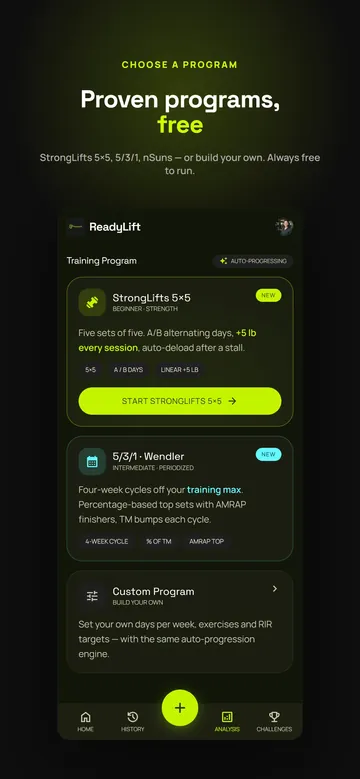
In ReadyLift (our app), you enter your one-rep maxes when you pick nSuns 5/3/1 LP. The app sets each training max at 90%, works out all 17 sets per day from it, and rounds every weight to 5 lb (2.5 kg). Each week you raise the training max yourself, using your 1+ reps and the table above, and the app recalculates every set.
How does nSuns compare with 5/3/1?
Both use a training max and the 5, 3, 1 rep pattern. Standard 5/3/1 moves the TM once per 4-week cycle and keeps sessions short; nSuns moves it weekly and adds far more volume. Both work well; the choice comes down to how much time and recovery you have.
| Program | Days/week | Progress | Best for |
|---|---|---|---|
| nSuns 5/3/1 LP | 4 to 6 | Weekly, from the 1+ set | Intermediates who love volume and have time for long sessions |
| 5/3/1 Boring But Big | 4 | Every 4-week cycle | Long-term progress with shorter sessions |
| Madcow 5x5 | 3 | Weekly | Lifters just past a beginner 5x5 |
Why it works. nSuns gives every main lift a heavy single, a lot of quality volume and a weekly test that sets the next week's weights. You find out quickly what you can handle. ReadyLift does the percentage math for all 17 sets, so the only number you have to think about is how many reps you got on the 1+ set.
Frequently asked questions
Is nSuns good for beginners?
It is built for intermediates. Beginners can usually add weight every session on a simpler plan like a 5x5 or Starting Strength, and the volume of nSuns is hard to recover from in the first months of lifting. It fits best once those simpler programs have stalled.
How long does an nSuns workout take?
Usually longer than other programs, often well over an hour once you add warm-ups and accessories. Seventeen main sets with proper rest takes time. Supersetting accessories and keeping rest short on the lighter T2 sets helps.
Which nSuns version should you run?
The 4-day version is the easiest to recover from and fit into a week. The 5-day version adds an overhead press day, and the 6-day versions add a squat or deadlift focus. Start with 4 days and add a day only if you recover well.
What if you fail the 1+ set?
Getting 0 or 1 rep means the training max stays where it is next week, so you get another go at the same weights. If the single keeps feeling like a max effort, your training max is probably set too high, and lowering it a little lets the weekly jumps carry you again.
Do you need to run accessories?
They are optional but useful. Two or three exercises for your back, arms and core cover what the main lifts miss. Keep them short so the T1 and T2 lifts get your best effort.
Sources
- Lift Vault, nSuns 5/3/1 LP spreadsheets (versions, training max, T1/T2 sets, TM progression, accessories).
- Jim Wendler (2009). 5/3/1: The Simplest and Most Effective Training System to Increase Raw Strength.
- American College of Sports Medicine (2009). Progression Models in Resistance Training for Healthy Adults. Medicine & Science in Sports & Exercise, 41(3), 687-708.
General training information, not medical advice. If you have an injury, a heart condition or another health concern, check with a doctor or physical therapist before starting a new program.

Written by the ReadyLift team. We build ReadyLift, a lifting log that runs nSuns 5/3/1 LP and other proven programs with the load math done for you. We link the original program write-ups and the research we rely on. Questions or corrections? Get in touch.