A 5x5 workout is a beginner barbell plan built on two alternating sessions, three days a week. Workout A is squat, bench press and barbell row; workout B is squat, overhead press and deadlift. You do 5 sets of 5 reps (one set of 5 on the deadlift) and add a small amount of weight every session until you stall.
Key takeaways
- Workout A: squat 5×5, bench press 5×5, barbell row 5×5. Workout B: squat 5×5, overhead press 5×5, deadlift 1×5.
- You alternate A and B on three non-consecutive days, so week one is A/B/A and week two is B/A/B.
- The usual jump is 5 lb (2.5 kg) per session on most lifts, with bigger early jumps on the deadlift.
- Miss reps? Repeat the weight. After three failed tries at the same weight, drop about 10% and build back up.
- When progress per session stops, a weekly program such as Madcow 5x5 is the natural next step.
In this guide
What is a 5x5 workout?
A 5x5 workout is a strength plan where each main lift is done for 5 sets of 5 reps at the same weight. The format goes back to coach Bill Starr's 1976 book The Strongest Shall Survive, and today the best-known version is StrongLifts 5×5: two full-body workouts, three days a week.
It is a linear progression. Every session you put a little more weight on the bar than last time. Beginners recover from a heavy squat in about two days, so the bar can keep climbing for months before you need anything more complicated.
Five sets of five sits right in the middle of the strength range. The American College of Sports Medicine's 2009 position stand on resistance training recommends heavy loads for low reps to build strength, and a 2 to 10% load increase once the target reps feel comfortable. For a beginner, that is almost every session.
What are the A and B workouts?
There are two workouts and both start with the squat. Workout A adds the bench press and the barbell row. Workout B adds the overhead press and the deadlift. You train three non-consecutive days a week, such as Monday, Wednesday and Friday, and alternate A and B every session.
| Workout A | Workout B |
|---|---|
| Squat 5×5 | Squat 5×5 |
| Bench press 5×5 | Overhead press 5×5 |
| Barbell row 5×5 | Deadlift 1×5 |
The deadlift gets one heavy set of 5 because you already squat three times a week; more pulling volume would slow recovery for the next squat day. Over any two weeks you do A three times and B three times, so the bench and press each get three sessions.
The sets are work sets only. Warm up first with the empty bar and a few lighter sets, then do all five sets at the working weight. Rest long enough to finish them with good form: a few minutes between heavy squat sets is normal.
How much weight do you add each session?
The standard jump is 5 lb (2.5 kg) per session on the squat, bench press, overhead press and row. The deadlift can start with 10 lb (5 kg) jumps, then drop to 5 lb. According to the StrongLifts progression guide, women often use 2.5 lb jumps on the bench and press.
| Lift | Per session (lb) | Per session (kg) |
|---|---|---|
| Squat | +5 lb (5 to 10 early on) | +2.5 kg |
| Bench press, overhead press, row | +2.5 to 5 lb | +1.25 to 2.5 kg |
| Deadlift | +10 lb at first, then +5 lb | +5 kg at first, then +2.5 kg |
Because the squat is in every session, small jumps add up fast: 5 lb three times a week is 15 lb a week. The upper-body lifts move more slowly, and fractional plates (1.25 lb or 0.5 kg) let you keep progressing on the press long after 5 lb jumps stop working.
Not sure what to load? Our free plate calculator shows exactly which plates go on each side for any weight.
What weight should you start with?
Start light. Many lifters begin with the empty bar (45 lb or 20 kg) on the squat, bench and press, and slightly heavier on the deadlift and row so the plates reach the right height. The first weeks feel easy, and that is the point: they build technique and a habit before the weight gets serious.
If you already lift, start each exercise at a weight you can do for 5 sets of 5 with good form and a rep or two left in reserve. Starting too heavy is the most common reason a 5x5 stalls in the first month.
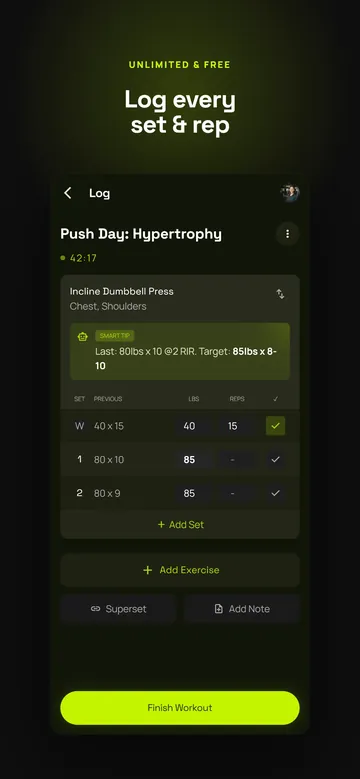
In ReadyLift (our app), you enter your starting weights once when you pick StrongLifts 5×5. The app builds the A/B calendar and puts the next weight on every set after that.
What do you do when you fail a set?
If you miss reps, repeat the same weight next session instead of adding more. The StrongLifts guide on failure says to try the weight up to three times. If you still miss it on the third attempt, deload: drop the weight about 10% and work back up with the normal jumps.
A deload is not a step backwards. The lighter weeks let you build momentum, and most lifters pass their old best within a few sessions. Check the basics before blaming the program: sleep, food, and enough rest between sets cause most early stalls.
When deloads stop working
If you deload a lift and stall again at about the same weight, you have run out of session-to-session progress on it. That is the signal to move to a program that adds weight weekly rather than every workout.
How does 5x5 compare with 3x5 programs?
The big difference is volume. A 5x5 does 25 work reps per lift; Starting Strength does 15 with 3 sets of 5, and swaps the barbell row for more deadlifting. Both are linear progressions that work well for beginners, so pick the one you will stick with.
| Program | Days/week | Main sets | Best for |
|---|---|---|---|
| 5x5 (StrongLifts 5×5) | 3 | 5×5 (deadlift 1×5) | Beginners who like more practice per lift and a row for the back |
| Starting Strength | 3 | 3×5 (deadlift 1×5) | The leanest version: fewer sets, faster sessions |
| GZCLP | 3 or 4 | 5×3+, 3×10, 3×15+ | Beginners who want strength plus more volume |
What should you run after 5x5?
The classic next step is Madcow 5x5. It keeps the same lifts and the 5x5 feel, but progress moves from every session to every week, with a heavy, a light and a medium day. Lifters who want percentages and more volume often go to nSuns 5/3/1 LP or 5/3/1 Boring But Big.
Why it works. Five sets of five gives you enough practice on each lift to learn it fast, and the steady jumps turn every workout into a small PR. A log that shows the next weight removes the guesswork: open the app, see the number, lift it. ReadyLift runs the A/B rotation for you and tracks every PR along the way.
Frequently asked questions
How long should you run a 5x5 workout?
Until you stop progressing session to session, which for most beginners takes a few months. There is no fixed end date: your log tells you. When deloads stop pushing a lift past its old best, it is time for a weekly program such as Madcow 5x5.
Is 5x5 good for building muscle?
Yes, especially for beginners. Heavy compound lifts with steady progress build muscle along with strength. If size is your main goal later on, a plan with more rep ranges, such as PHUL or a push pull legs split, adds the higher-rep work that 5x5 leaves out.
Can you do 5x5 twice a week?
The plan is built for three sessions a week, because three squat days drive most of the progress. Twice a week still works, but progress is slower and you may need smaller jumps. If you can only train twice, keep alternating A and B so both workouts get done.
Why only one set of deadlifts?
You already squat heavy every session, which works the same legs and back. One hard set of five deadlifts is enough to make it go up, and more pulling volume usually hurts your next squat session more than it helps the deadlift.
Do you need to add accessories?
No. The plan works on its own, and early on the main lifts are enough. Many lifters add a little arm or core work at the end once the sessions are comfortable. Keep it short so it never cuts into recovery for the main lifts.
Sources
- StrongLifts, How to Progress (per-session increments).
- StrongLifts, What to Do When You Fail (repeat, then deload about 10%).
- Bill Starr (1976). The Strongest Shall Survive: Strength Training for Football.
- American College of Sports Medicine (2009). Progression Models in Resistance Training for Healthy Adults. Medicine & Science in Sports & Exercise, 41(3), 687-708.
General training information, not medical advice. If you have an injury, a heart condition or another health concern, check with a doctor or physical therapist before starting a new program.

Written by the ReadyLift team. We build ReadyLift, a lifting log that runs StrongLifts 5×5 and other proven programs with the load math done for you. We link the original program write-ups and the research we rely on. Questions or corrections? Get in touch.