The PHUL workout (Power Hypertrophy Upper Lower) is a four-day split by Brandon Campbell. You train upper and lower body twice a week each: one heavy "power" day for 3 to 5 reps and one "hypertrophy" day for 8 to 15 reps. That pairing builds strength and muscle at the same time. Every muscle gets trained twice a week.
Key takeaways
- The week is Upper Power, Lower Power, rest, Upper Hypertrophy, Lower Hypertrophy, then two rest days.
- Power days build around bench, rows, squats and deadlifts for 3 to 5 reps; hypertrophy days use 8 to 12 and 10 to 15.
- Campbell's one effort rule: finish every set with at least one rep left in the tank.
- The original gives no progression rule. Double progression fits it well: hit the top of the rep range on every set, then add weight.
- Training each muscle twice a week is linked to more growth than once a week in a 2016 meta-analysis.
In this guide
What is the PHUL workout?
PHUL is a powerbuilding program written by Brandon Campbell and published on Muscle & Strength in February 2013, last updated in May 2021. It splits the body into upper and lower halves and trains each half twice a week, once heavy and once for volume.
The heavy days keep the big lifts in the 3 to 5 rep range, where heavier loads favor strength gains. The volume days use 8 to 15 reps and more exercises per muscle, which suits muscle growth. You get a strength program and a bodybuilding program in the same four days.
What does the PHUL workout split look like?
Campbell's layout is four training days and three rest days. The two power days come first, back to back, followed by a rest day and then the two hypertrophy days. A common way to run it is Monday, Tuesday, Thursday and Friday, with the weekend off.
| Day | Session | Rep focus |
|---|---|---|
| Monday | Upper Power | 3 to 5 on main lifts |
| Tuesday | Lower Power | 3 to 5 on main lifts |
| Wednesday | Rest | |
| Thursday | Upper Hypertrophy | 8 to 12 |
| Friday | Lower Hypertrophy | 8 to 15 |
| Weekend | Rest |
What exercises are in each PHUL day?
Each day has five to seven exercises. The power days open with two heavy barbell lifts, then move to moderate-rep accessories. The hypertrophy days swap the big barbell lifts for variations, such as incline bench and front squats, and stay in the 8 to 15 range throughout. The sets and reps below follow Campbell's original.
Upper Power
| Exercise | Sets | Reps |
|---|---|---|
| Barbell bench press | 3 to 4 | 3 to 5 |
| Incline dumbbell bench press | 3 to 4 | 6 to 10 |
| Bent-over row | 3 to 4 | 3 to 5 |
| Lat pulldown | 3 to 4 | 6 to 10 |
| Overhead press | 2 to 3 | 5 to 8 |
| Barbell curl | 2 to 3 | 6 to 10 |
| Skullcrusher | 2 to 3 | 6 to 10 |
Lower Power
| Exercise | Sets | Reps |
|---|---|---|
| Squat | 3 to 4 | 3 to 5 |
| Deadlift | 3 to 4 | 3 to 5 |
| Leg press | 3 to 5 | 10 to 15 |
| Leg curl | 3 to 4 | 6 to 10 |
| Calf raise | 4 | 6 to 10 |
Upper Hypertrophy
All exercises are 3 to 4 sets of 8 to 12: incline barbell bench press, flat dumbbell fly, seated cable row, one-arm dumbbell row, dumbbell lateral raise, seated incline dumbbell curl, and cable triceps extension.
Lower Hypertrophy
| Exercise | Sets | Reps |
|---|---|---|
| Front squat | 3 to 4 | 8 to 12 |
| Barbell lunge | 3 to 4 | 8 to 12 |
| Leg extension | 3 to 4 | 10 to 15 |
| Leg curl | 3 to 4 | 10 to 15 |
| Seated calf raise | 3 to 4 | 8 to 12 |
| Calf press | 3 to 4 | 8 to 12 |
Campbell says beginners should start at the lower end of the set ranges. He keeps the main compound lifts fixed but allows like-for-like swaps for accessories, such as a machine row for a cable row. Ab work goes at the end of a session or on rest days.
How do you progress on PHUL?
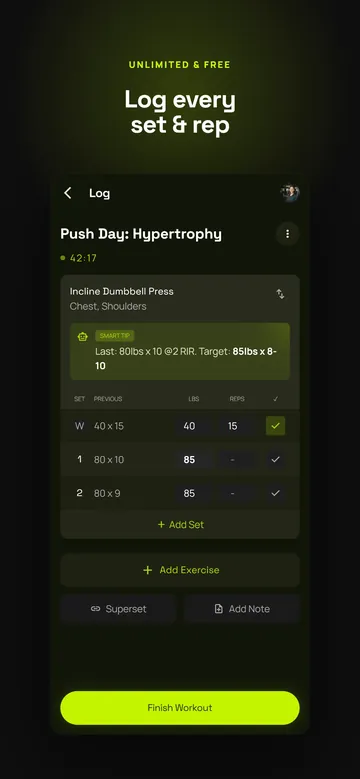
The original program gives no progression rule, so you need one. Double progression fits PHUL's rep ranges well. Keep the weight until you hit the top of the range on every set, then add weight and work back up from the bottom. On the power days, that means going from 3 reps to 5 reps before adding load.
For example, if your power-day bench is 4 sets of 3 to 5 at 185 lb, you stay at 185 until all four sets reach 5 reps. Then you go to 190 and start again at 3 to 4 reps per set. On a hypertrophy-day lat raise at 3 sets of 8 to 12, you add the smallest jump once all three sets reach 12.
That rule matches the American College of Sports Medicine's 2009 guidance: increase the load by 2 to 10% once you can do one or two reps beyond your target. Use 5 lb (2.5 kg) jumps on compound lifts and 2.5 lb (1.25 kg) or the smallest dumbbell step on isolation work.
How hard should each set be?
Campbell's only effort rule is that every set ends with "at least 1 rep left in the tank." In today's terms that is about 1 rep in reserve (RIR). Leaving a rep keeps your form clean on heavy days and lets you recover in time for the next session on the same muscles.
RIR is a practical way to track that. Zourdos and colleagues (2016) validated an RIR-based effort scale and found experienced lifters rated it more accurately than novices. Logging RIR with each set shows you when a weight is getting easier, before the reps show it.
Rest times aren't in the program. Two to three minutes is a common guideline, and the heavy 3 to 5 rep sets usually need the full three.
Who is PHUL best for?
PHUL fits lifters with four training days who want strength and size, not one at the expense of the other. It is a common step after a beginner program such as GZCLP or Starting Strength, when adding weight every session no longer works.
The twice-a-week frequency is a strength of the program. A 2016 meta-analysis by Schoenfeld, Ogborn and Krieger found that training each muscle group at least twice a week produced more growth than once a week. PHUL builds that in without six gym days.
How does PHUL compare with PPL and PHAT?
All three mix strength and size work; they differ in days per week and how the body is split. PHUL is the four-day middle ground. Reddit PPL trains six days and keeps the main lifts on linear progression. PHAT, by Layne Norton, adds a fifth day and splits the hypertrophy work by body part.
| Program | Days/week | Split | Best for |
|---|---|---|---|
| PHUL | 4 | Upper/lower, power and hypertrophy days | Strength plus size on a 4-day schedule |
| Reddit PPL | 6 | Push/pull/legs twice | Lifters who like daily training and more volume |
| PHAT | 5 | 2 power days, 3 body-part hypertrophy days | Experienced lifters chasing more volume |
| 5/3/1 BBB | 4 | One main lift per day plus 5×10 | Steady strength with simple volume |
Why it works. PHUL hits every muscle twice a week with both heavy and moderate reps, and double progression gives every exercise a clear next step. ReadyLift has PHUL built in, tracks each rep range separately, and tells you when you have earned the next weight.
Frequently asked questions
Is the PHUL workout good for beginners?
It can be, if you start with the lower set counts as Campbell suggests. Many lifters run a simpler linear program first, because adding weight every session is the fastest way to get strong early. PHUL works well once that slows down, or for beginners who want more muscle-building volume from day one.
How long should you run PHUL?
As long as the weights keep moving. Because double progression lets you add reps before weight, PHUL can run for many months. When a lift stops progressing for a few weeks, take a lighter week, then work back up from the bottom of the rep range.
Is PHUL better than PPL?
Neither is better in general. PHUL trains four days and pairs heavy and moderate work for every muscle. PPL trains six days with more total volume. If four days fits your week, PHUL is easier to stick with, and consistency matters more than the split.
How long does a PHUL workout take?
Mostly it depends on your rest times. Power days take longer because the heavy sets need longer rest. Hypertrophy days have more exercises but shorter rests. Supersetting accessories, such as curls with triceps work, saves time.
Can you swap exercises on PHUL?
Yes, for like-for-like accessories. Campbell keeps the main compounds (bench, row, squat, deadlift) fixed but allows swaps such as dumbbell rows for cable rows. Keep the rep ranges and the muscle being trained the same.
Sources
- Brandon Campbell (2013, updated 2021). Power Hypertrophy Upper Lower (P.H.U.L.) Workout. Muscle & Strength.
- American College of Sports Medicine (2009). Progression Models in Resistance Training for Healthy Adults. Medicine & Science in Sports & Exercise, 41(3), 687-708.
- Schoenfeld, Ogborn & Krieger (2016). Effects of Resistance Training Frequency on Measures of Muscle Hypertrophy. Sports Medicine, 46(11), 1689-1697.
- Zourdos et al. (2016). Novel Resistance Training-Specific Rating of Perceived Exertion Scale Measuring Repetitions in Reserve. Journal of Strength and Conditioning Research, 30(1), 267-275.
General training information, not medical advice. If you have an injury, a heart condition or another health concern, check with a doctor or physical therapist before starting a new program.

Written by the ReadyLift team. We build ReadyLift, a lifting log that runs PHUL and other proven programs with the load math done for you. We link the original program write-ups and the research we rely on. Questions or corrections? Get in touch.