The Starting Strength program is a beginner barbell plan built on two alternating workouts, three days a week. Each session you squat 3 sets of 5, press or bench 3 sets of 5, and deadlift 1 set of 5, adding a little weight every time. It is a novice linear progression: you keep adding weight until the bar stops moving, then you reset or move on.
Key takeaways
- Workout A is squat, bench and deadlift; workout B is squat, press and deadlift. You alternate them on three non-consecutive days.
- Work sets are 3×5 for squat and the presses and 1×5 for the deadlift. Warm-up sets don't count.
- Most men start with 10 lb jumps on the squat for two or three sessions, then 5 lb. Women and older lifters use smaller jumps.
- The official reset after two failed sessions in a row is a 5 to 10% drop in load, not a new program.
- When resets stop working, you move to intermediate programming such as the Texas Method.
In this guide
- What is the Starting Strength program?
- What are the Starting Strength workouts?
- How does the program change over time?
- How much weight should you add each session?
- What weight should you start with?
- What do you do when you fail a lift?
- How does it compare with other beginner programs?
- What should you run after Starting Strength?
- FAQ
What is the Starting Strength program?
Starting Strength is Mark Rippetoe's novice program, published on startingstrength.com and in his book of the same name. It uses five barbell lifts and three sessions a week. The idea is simple: a beginner can recover from a heavier squat in 48 hours, so you add weight every single workout until you can't.
That is what "linear progression" means. There are no percentages and no weekly waves. The weight on the bar goes up in a straight line for as long as your body adapts that fast, which for most beginners is a few months.
Three sessions a week also clears the CDC's guideline of muscle-strengthening work on two or more days a week. It works because it matches how fast new lifters recover. The American College of Sports Medicine's 2009 position stand on resistance training recommends a 2 to 10% load increase once you can do the target reps with one or two to spare. For a beginner, that condition is true almost every session.
What are the Starting Strength workouts?
There are two workouts, A and B, and they differ by one lift. Both start with 3 sets of 5 squats and finish with a single set of 5 deadlifts. Workout A uses the bench press in the middle; workout B uses the standing overhead press. You train on three non-consecutive days, such as Monday, Wednesday and Friday.
| Workout A | Workout B |
|---|---|
| Squat 3×5 | Squat 3×5 |
| Bench press 3×5 | Press 3×5 |
| Deadlift 1×5 | Deadlift 1×5 |
Because you alternate, week one is A/B/A and week two is B/A/B. Over any two weeks you bench three times and press three times. The squat is in every session, which is why it climbs fastest.
The numbers are work sets only. Warm up with an empty bar and a few lighter sets, then do your three heavy sets at the same weight. Rest long enough to complete them; three to five minutes on squats is common.
How does the program change over time?
The official program has three phases. Phase 1, usually one to three weeks, is the A/B layout above. In phase 2 the power clean (3 sets of 3) replaces the deadlift on B days. In phase 3, chin-ups join B days and the deadlift alternates with the power clean on A days.
Late in the novice phase, the squat gets a lighter day. According to the program page, the "advanced novice" adds weight to the squat only twice a week and squats lighter on Wednesday so the heavy days keep going up. Chin-ups become weighted once you can do 3 sets of 10 at bodyweight.
Many lifters run phase 1 for much longer than three weeks, and that is fine. If you have no platform for cleans, or no coach to teach them, the A/B version still gives you a full novice run on the four big lifts.
How much weight should you add each session?
For healthy men aged roughly 18 to 40, Starting Strength suggests 10 lb jumps on the squat for the first two or three sessions, then 5 lb per workout. The deadlift can jump 15 to 20 lb at first, then 10 lb, then 5. The press and bench usually go up 5 lb a session, later 2.5 lb or less.
| Lift | Early sessions | Most of the novice phase | Late novice |
|---|---|---|---|
| Squat | +10 lb | +5 lb | +5 lb, twice a week |
| Deadlift | +15 to 20 lb | +10 lb | +5 lb |
| Bench and press | +5 to 10 lb | +5 lb | +2.5 lb or smaller |
Women and older lifters use smaller jumps from the start. In kilograms, think 5 kg for the early squat and deadlift jumps and 2.5 kg for the presses. Small plates (1.25 lb or 0.5 kg) keep the bench and press moving much longer.
What weight should you start with?
Start each lift with a weight you can do for 5 clean reps with a few left in the tank. Warm up in sets of 5, adding weight until the bar speed slows noticeably, then use the last fast set as your first work set. Starting too light costs a session or two; starting too heavy costs weeks.
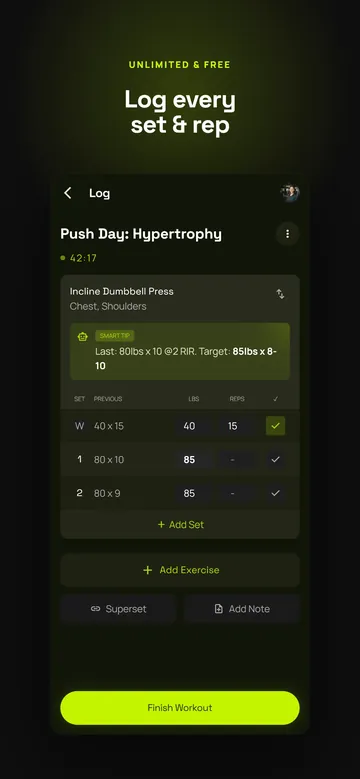
Write down where you started. The first month goes quickly, and a clean log is how you tell a bad day from a real stall. In ReadyLift (our app), you enter your starting weights once when you pick Starting Strength, and the app fills in the next weight for every set after that.
What do you do when you fail a lift?
Starting Strength's official answer is a reset: a 5 to 10% drop in load with the program otherwise unchanged. In "The Reset: Why and How" (2018), coach Rori Alter says to reset 5% after failing the same sets two sessions in a row, provided sleep and food were adequate.
The article also covers a single missed workout. If you miss reps once, rest three extra minutes and finish the volume in smaller sets. Next session, either repeat the weight with 2.5 lb jumps afterwards, or switch that lift to 5 sets of 3 at the same weight.
After time off
After a week away, repeat your last workout. After a longer break, reset 5% if you are under 40 and 10% if you are over 40. After three to four weeks off, reset 10% regardless of age.
When the reset stops working
A reset buys you more weeks of linear progress, often with a lighter squat day added at this point. When you stall again soon after a reset, the novice phase is ending. That is the signal to change programs, not to grind harder.
How does it compare with other beginner programs?
Starting Strength is the leanest of the popular beginner programs: three main lifts a day and no accessories. Other plans add volume or arm work. All of them are linear progressions, so the right choice is the one that fits your schedule and that you will finish.
| Program | Days/week | Main sets | Best for |
|---|---|---|---|
| Starting Strength | 3 | 3×5 (deadlift 1×5) | Pure strength on the barbell basics |
| GZCLP | 3 or 4 | 5×3+, then 3×10 and 3×15+ | Strength plus more volume and back work |
| Reddit PPL | 6 | 5s on the main lifts, 8 to 20 on accessories | Lifters who want size and more gym days |
What should you run after Starting Strength?
Rippetoe's own next step is Practical Programming, where progress moves from every session to every week. The Texas Method is the classic example: a volume day, a light day and a heavy day. Many lifters instead move to 5/3/1 Boring But Big, which progresses once a month and adds a lot of volume.
If you want more muscle along with strength, an upper/lower plan like the PHUL workout is a natural next step. It keeps heavy sets of 3 to 5 and adds higher-rep work for size.
Why it works. Starting Strength strips training down to the lifts that move the most weight, then adds a small, steady amount every session. A log that puts the next weight in front of you turns that into a habit: open the app, see the number, lift it. ReadyLift builds the A/B rotation for you and tracks every PR along the way.
Frequently asked questions
How long does the Starting Strength program last?
There is no fixed length. You run it until linear progress stops. According to the program page, phase 1 usually lasts one to three weeks and phase 2 anywhere from several weeks to several months. Your log, not the calendar, tells you when it is over.
Can you run Starting Strength twice a week?
The program is built for three sessions a week, because three squat sessions drive most of the progress. Two sessions will still make you stronger, but more slowly, and you will need smaller jumps. If you can only train twice, a full-body plan built for two days is a better fit.
Why is the deadlift only one set of five?
Because you squat heavy three times a week, your lower back and legs already get plenty of work. One hard set of deadlifts after the squats is enough to make it go up. Doing more usually slows recovery for the next squat session.
Is Starting Strength good for women and lifters over 40?
Yes. The program page recommends smaller increments for women and older lifters, and the reset article gives a bigger reset after time off for lifters over 40. The lifts and the structure stay the same; only the jump sizes change.
Do you need to do power cleans?
The official phases add power cleans, but plenty of lifters run the A/B version with deadlifts only. If you have a coach and bumper plates, learn the clean. If not, keep deadlifting and you still get a full novice run on the big four lifts.
Sources
- Starting Strength, The Starting Strength Programs (phases, increments, advanced novice).
- Rori Alter, DPT (2018). The Reset: Why and How. Starting Strength.
- American College of Sports Medicine (2009). Progression Models in Resistance Training for Healthy Adults. Medicine & Science in Sports & Exercise, 41(3), 687-708.
- CDC, Adult Activity: An Overview (muscle-strengthening on 2 or more days a week).
General training information, not medical advice. If you have an injury, a heart condition or another health concern, check with a doctor or physical therapist before starting a new program.

Written by the ReadyLift team. We build ReadyLift, a lifting log that runs Starting Strength and other proven programs with the load math done for you. We link the original program write-ups and the research we rely on. Questions or corrections? Get in touch.